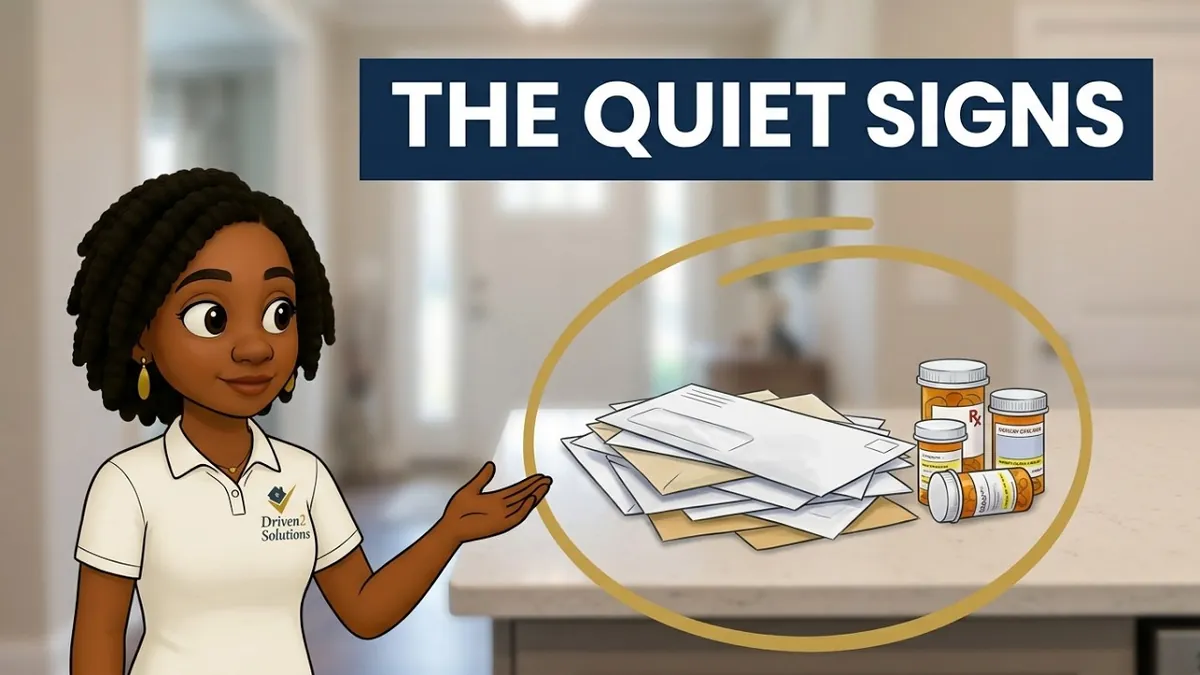
The hardest part of a senior move is rarely the move. It is the first conversation — and how it opens usually decides how it goes.
Adult children usually arrive at this conversation having already had it several times in their own head. They have noticed the stairs, the mail piling up, the missed appointment. By the time they raise it out loud, they have often reached a conclusion.
The parent, meanwhile, is hearing it for the first time — and hearing something quite specific: you think I can no longer manage my own life. That gap is where most of these conversations go wrong.
Open with their priorities, not your conclusion
A conversation that opens with "we think it is time to sell the house" is a verdict. A conversation that opens with a question is a conversation.
- What would you like the next few years to look like?
- What parts of the house are working well, and what has become a nuisance?
- If something changed suddenly, what would you want us to do?
- What would you not want to happen?
That last one is often the most productive question in the room. People who resist every proposal will frequently tell you very clearly what they are afraid of, and the fear is usually more specific and more solvable than the resistance suggested.
Do not try to finish it in one sitting
A first conversation that ends with nothing decided has not failed. It has done its job: the subject is now open, and it can be returned to without ambush.
Families who push for a decision in one afternoon tend to get either a defensive no or an agreement that quietly reverses within a week. Neither is progress.
Separate the care question from the house question
These get tangled together constantly, and they are different problems on different clocks.
The care question is: what level of support does this person need, now and plausibly soon? That is answered with medical input, care professionals, and honest observation.
The house question is: what happens to the property, in what order, and on what timeline? That is answered with condition, costs, contents, and the family's actual constraints.
Answering the care question first almost always makes the house question easier, because it supplies the timeline that the property decision has been missing.
Give the house its due
It is worth saying plainly to a parent that you understand the house is not just an asset. It is where things happened. Families who acknowledge that directly tend to have far less resistance than families who move straight to logistics — because the resistance was never really about logistics.
A move out of a long-time home involves belongings, timing, vendors, and family feelings — long before it involves a listing.
When you want someone outside the family
Sometimes the same sentence lands differently coming from someone who is not a son or daughter. A neutral person can lay out the practical options without the decades of history attached, which occasionally lets a family have the conversation they have been circling for a year.
That is a large part of what we do. Not to advocate for a move — often the conversation concludes that staying is right — but to make sure the options are understood before anyone commits to one.